What is digital health design
The landscape of digital health products, who uses them, and why designing for healthcare is fundamentally different from general product design.
Digital health design is the practice of designing software products used in healthcare: the screens clinicians read between patients, the apps people check after a diagnosis, and the systems that move health data between the two. It sits at the intersection of product design, health informatics, and clinical workflow — and it is not the same as designing a consumer app that happens to involve health.
What counts as a digital health product
The field covers a wide range of product types, each with a different primary user and set of constraints:
- Electronic Medical Records (EMR/EHR) - clinician-facing systems for documenting patient care. Dense, keyboard-driven, built for speed across dozens of patients a day.
- Patient portals - the patient-facing window into their own health data: lab results, appointments, medications. The challenge is translating clinical data into something a non-clinician can act on.
- Telehealth / virtual care - video consultations, asynchronous messaging, remote triage. Trust and perceived quality of care depend heavily on interface design.
- Remote Patient Monitoring (RPM) - devices and dashboards that track vitals (blood pressure, glucose, oxygen) outside the clinic. Two distinct interfaces: the patient's device/app and the clinician's multi-patient dashboard.
- Wellness and self-management apps - broader than clinical, covering mental health, fitness, chronic-condition tracking. Closer to consumer product design, but still subject to health-specific expectations around accuracy, privacy, and tone.
- Health information systems - administrative and operational tools: scheduling, billing, referral management, pharmacy systems. Less visible but massive in scope.
Who uses these products
Most digital health products serve at least two user groups whose needs are fundamentally different:
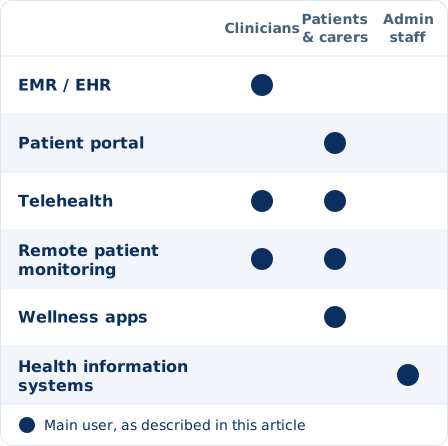
- Clinicians (doctors, nurses, allied health) - expert users who need speed, density, and precision. They are scanning, not reading. Every extra click is time taken from a patient.
- Patients and carers - occasional users who may be stressed, unwell, or have low digital confidence. They need interpretation, not raw data. Clarity and reassurance matter more than feature count.
- Administrators - schedulers, billing staff, system managers. They need throughput and error prevention across high-volume repetitive tasks.
Why it differs from general product design
Several things make digital health design materially different from designing a typical SaaS product or consumer app:
- Errors have clinical consequences - a misread dosage, a missed alert, or a confusing consent screen is not just a UX problem. Design decisions carry patient-safety weight.
- Regulation is not optional - accessibility is a legal duty in many places, and several major instruments name WCAG 2.1 Level AA (for example US health and public-sector rules, and the EU's EN 301 549); WCAG 2.2 is the current version and builds on 2.1. Privacy laws (HIPAA, GDPR, Australia's Privacy Act) constrain what you can show, store, and share.
- Two design languages - the same underlying data (e.g. a blood-pressure reading) must be presented differently for a clinician scanning ten patients and a patient checking their own trend. This is not a theming exercise; it is a fundamentally different information architecture.
- Regulation is not optional - accessibility is a legal duty in many places, and several major instruments name WCAG 2.1 Level AA (for example US health and public-sector rules, and the EU's EN 301 549); WCAG 2.2 is the current version and builds on 2.1. Privacy laws (HIPAA, GDPR, Australia's Privacy Act) constrain what you can show, store, and share.
- Trust is fragile - patients decide whether to trust a health product within seconds. Visual credibility, consistent tone, and transparent data handling build trust; a single dark pattern or confusing screen can destroy it.
Where this series goes from here
This article is the entry point. The rest of the Foundations series works through the core topics in the order you need them - starting with the most decisive distinction in the field (clinical vs patient interfaces), then moving through health literacy, trust, vulnerable users, accessibility law, design patterns, data visualisation, and research process. Each article starts from the healthcare context, then brings in design knowledge - not the other way around.